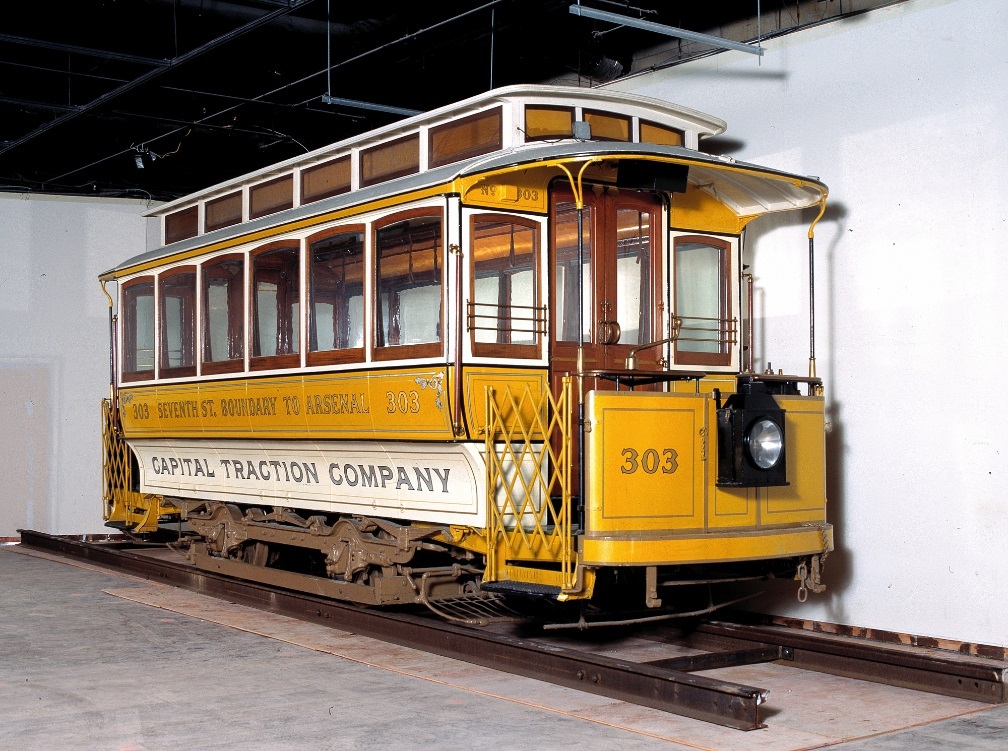
Capital Traction 303
Facts and Figures
| Current Number | 303 |
|---|
| Railway Represented | Capital Traction |
|---|
| Builder | American Car Company |
|---|
| Built In | 1898 |
|---|
| Builder's order id | |
|---|
| Currently in (State) | District of Columbia |
|---|
| --(Locality) | Washington |
|---|
| Totally out of svc date | 1933 |
|---|
| (Initial retirement date) | 1913 |
|---|
| Car Type | streetcar |
|---|
| -subtype | conduit car |
|---|
| -designation | |
|---|
| Status | displayed inoperable |
|---|
| More info | |
|---|
| Gauge | 4'8.5" |
|---|
| Construction | wood |
|---|
| Roof type | DR |
|---|
| Ended | DE |
|---|
| Length | 25'6" |
|---|
| Width | 7'8" |
|---|
| Height | 11'1" |
|---|
| Weight | 19990 |
|---|
| #Seats | 26 |
|---|
| #Wheels/Conf. | 4 |
|---|
| Total HP | 70 |
|---|
| Trucks | Lord Baltimore |
|---|
| Brakes | Hand |
|---|
| Compressor | n/a |
|---|
| Control | |
|---|
| Motors | GE 1000 (2) |
|---|
| Voltage (if not 600DC) | |
|---|
|
|
|
|
Car History by Wesley Paulson
Capital Traction 303
One of Washington's most spectacular fires occurred on September 29, 1897 when the Capital traction Company (CTCo) powerhouse burned to the ground. The loss of this plant brought the Company's cable operations to a halt. CTCo immediately converted its cable cars for horse car operation and service resumed the next day. With the loss of the cable system, the Company proceeded to electrify its routes and to order cars for this service. A month after the fire, the Company directors approved an order of seventy cars from the American Car Company of St. Louis, Missouri, which included what would become Capital Traction 303.
As specified in the order, American applied exterior paint schemes and assigned roster numbers based upon the routes the cars would serve. As originally constructed, the car was painted yellow and cream, numbered and lettered as CTCo 303 and assigned to the 7th Street route. The cars in this order pulled open and closed trailers which were also numbered in a similar manner. Thus CTCo motor 303 was used in service with companion trailer 303.
Two events in the early 1900s changed the appearance of CTCo 303. An order of the District of Columbia Electric Railway Commission altered the classic lines of the car by requiring enclosed platforms. CTCo installed "portable vestibules" to fulfill the requirement by January 31, 1905. In 1906, CTCo stopped lettering the exterior of its cars for specific routes and renumbered its single truck cars and trailers. In the process, CTCo 303 traded its yellow and cream paint for a simpler green and cream scheme, and continued to serve on the 7th Street route. In 1912, The District of Columbia Public Utilities Commission issued an order requiring a conductor on each car. As a result, CTCo withdrew all single truck passenger equipment from service on January 31, 1913. CTCo sold a large number of these surplus cars in the next few years, but retained CTCo 303 in storage.
The arrival of the PCC cars in 1937 brought CTCo 303 into the spotlight as part of a parade to introduce the new cars to Washington. Coupled with trailer 1512, CTCo 303 operated briefly again on the streets of Washington on August 27, 1937. Capital Transit cars 1101, 1106 and another new car toured the city with the train leading the way as a publicity stunt.
CTCo 303 sat idle during the war years and was not used again until 1949. By then, Fay Johnson of Capital Transit had seen that a trolley pole was added to the roof of CTCo 303. For the first time in the car's fifty-one year life motormen did not have to turn back at the plow pit. The car traveled on all overhead lines in the city limits. However the maintenance of way and car departments had a concern that a derailment on open track could damage the chilled-iron wheels of the Lord Baltimore truck, so CTCo 303 did not venture to distant Branchville and Cabin John on those suburban lines in Maryland. Capital Transit, and later DC Transit continued to offer CTCo 303 and 1512 for fan trip service until CTCo 303 pulled a plow on a trip in 1961.
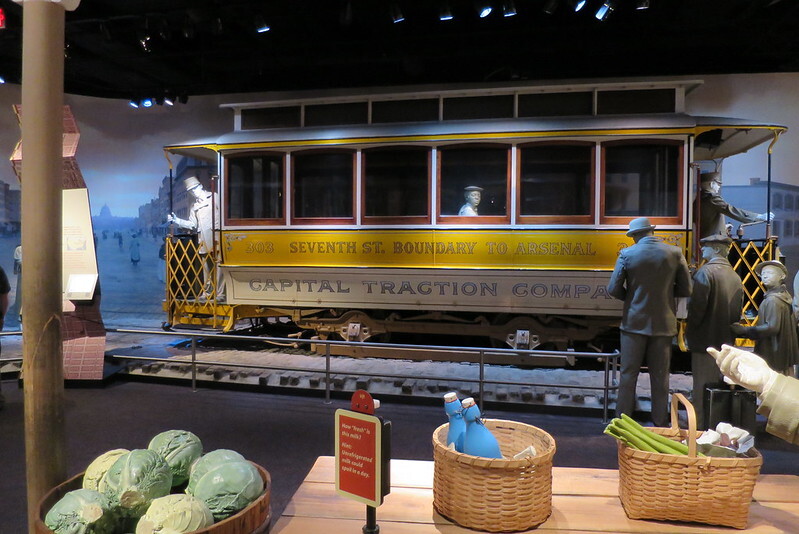
Under the management of O. Roy Chalk, DC Transit retained ownership of CTCo 303 after streetcar service ended on January 28, 1962. During the 1960s, Mr., Chalk dispatched the train to the company's main bus facility in Bladensburg, where the shop crew restored the cars' exterior appearance to its 1898 appearance. Chalk had the train and its motor car installed in the boardroom on the main floor of the former carhouse at 36th & M Streets, where they remained until donation to the Smithsonian in the early 1970s. CTCo 303 is now an exhibit in the Museum of American History.
Ownership History
| Owner | Car Num | From | To | Preservation? | Loan? |
|---|
| Capital Traction
(District of Columbia, Washington) | 303 | 1898 | 1933 | NO | NO |
| Capital Transit
(District of Columbia, Washington) | 303 | 1933 | 1956 | YES | NO |
| DC Transit
(District of Columbia, Washington) | 303 | 1956 | 1975 | YES | NO |
| Smithsonian Institution
(District of Columbia, Washington) | 303 | 1975 | present | YES | NO |
Additional Media